
Working Memory in Children: Evidence-Based Guidance for Parents
Working Memory (WM): An Introduction
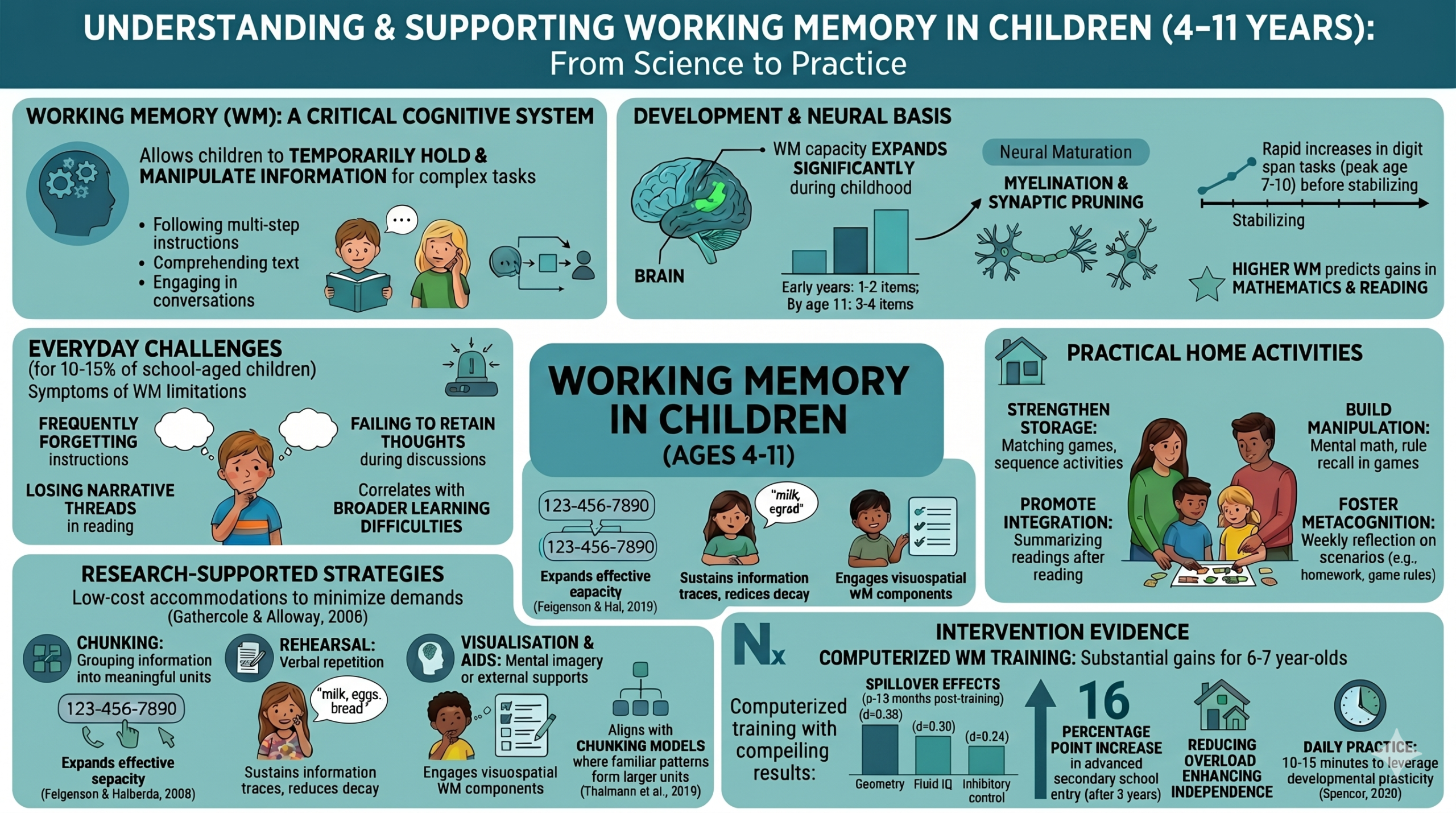
Working memory (WM) is a core cognitive process that enables children to hold a limited amount of information temporarily while simultaneously manipulating it to complete tasks like planning actions, solving problems, or following conversations (Gathercole & Alloway, 2008). Unlike short-term storage, which merely retains information passively for a few seconds, WM actively updates, reorganizes, and processes information in real time. This dynamic manipulation makes WM essential for learning, reasoning, and daily functioning. For example, when a child follows the instruction “Put on your shoes, then wash your hands, and finally wait by the door,” they must hold each step in mind while executing the first action – all without being distracted. This article draws on peer-reviewed studies to explain WM development, common challenges, proven strategies, and structured activities for parents supporting children aged 4–11.
Development and Neural Basis
WM undergoes profound changes during childhood, with capacity growing from just 1–2 items around age 4 to 3–4 items by age 11. This expansion is influenced by key brain maturation processes, including increased myelination in prefrontal areas (which speeds neural communication) and synaptic refinement (pruning of unused connections) (Spencer, 2020; Ahmed et al., 2022). Longitudinal data from large cohorts reveal nonlinear trajectories: forward digit span (simple recall of numbers in the order presented) surges early, between ages 3 and 5, while backward digit span (recalling numbers in reverse order, which tests mental manipulation) accelerates later, around ages 7 to 10, before plateauing into adolescence (Ahmed et al., 2022; Reynolds & Cowan, 2016).
For example, a typical 5-year-old might successfully recall the sequence “2-4-7” forward but struggle to say “7-4-2” backward. In contrast, a 9-year-old can often handle “3-8-1-5” correctly in both directions. Neural models posit that WM relies on self-sustaining circuits where an excitatory-inhibitory balance maintains distinct “peaks” of neural activity representing each item; these circuits are strengthened through experience-dependent plasticity (Spencer, 2020). This developmental growth directly underpins school success, with WM explaining up to 50% of the variance in math and reading outcomes (Gathercole & Alloway, 2008). In other words, a child’s working memory capacity is one of the strongest predictors of how readily they acquire new academic skills.
Everyday Challenges
Children with WM limitations – estimated to be prevalent in 10–15% of the school population – often exhibit specific, observable struggles tied to capacity overload (Gathercole & Alloway, 2008). Because their mental “workspace” fills up quickly, they may forget the second or third step in a multi-step instruction (e.g., “shoes, bag, door”), lose plot details mid-way through a story, or go blank on a thought while raising their hand to speak. These lapses frequently lead to frustration, reduced independence, and even behavioral avoidance of tasks that seem too mentally demanding (Gathercole & Alloway, 2008).
Real-world examples include a child abandoning a multi-part homework assignment after completing only the first item, or repeatedly asking for the rules of a board game despite having just received an explanation. These daily difficulties cascade into broader challenges, correlating strongly with lower academic attainment and attention difficulties such as those seen in ADHD (Ahmed et al., 2022). Importantly, many parents mistakenly view these behaviors as laziness or defiance, when in fact the child’s working memory is simply overwhelmed.
Research-Supported Strategies
Rigorous studies validate several practical strategies that offload WM demands without requiring expensive training programs or software. These strategies exploit the multicomponent nature of WM – verbal, visual, and central executive systems – to create immediate gains (Thalmann et al., 2019).
Chunking: Organizing information into familiar, meaningful groups boosts effective capacity. Young children can track 3–4 “chunks” (e.g., treating “cat-dog” as one unit) versus isolated items (Feigenson & Halberda, 2008; Thalmann et al., 2019). Example: Teach phone numbers as “077-123-4567” instead of eleven separate digits.
Rehearsal: Silent or overt repetition refreshes decaying memory traces, and is especially effective for verbal information (Gathercole & Alloway, 2008). Example: A child whispers “brush teeth, pajamas, story” repeatedly while walking to the bathroom.
Visualization and aids: Diagrams, checklists, or mental images tap into visuospatial WM, freeing up limited verbal resources (Gathercole & Alloway, 2008). Example: Before cleaning a playroom, sketch a simple room layout and mark where toys belong, so the child refers to the drawing instead of holding locations in mind.
These strategies do not train WM directly but reduce its workload, enabling children to perform closer to their potential in real-time situations.
Practical Home Activities
Evidence favors interactive, repeated practice that mimics real-world demands rather than rote drills. The following activities are easy to integrate into daily routines:
Matching games: Card pair games train visual-spatial hold and retrieval (Gathercole & Alloway, 2008). Example: Play Concentration (memory match) with 12–24 cards, requiring the child to recall positions over successive turns.
Sequence repetition: Build digit or letter chains, gradually increasing length (Ahmed et al., 2022). Example: Say “apple, banana” and have the child repeat; add “cherry” the next day, building to “apple, banana, cherry, date, elderberry.”
Reading summarization: Pause after a paragraph or page to recap key points and link them to prior knowledge (Gathercole & Alloway, 2008). Example: After a page, ask, “What just happened?” and prompt, “The boy found a treasure map. Where do you think he will go next?”
Mental math: Practice addition and subtraction without paper to strengthen manipulation of numerical information (Ahmed et al., 2022). Example: “What is 7 + 5? Now subtract 3 from that total.”
Rule recall: Before playing a board game, have the child visualize and verbally state the steps (Gathercole & Alloway, 2008). Example: For Monopoly, ask, “What do you do first, second, and third on your turn?”
Incorporate 10-minute sessions 4–5 days per week, and end with child-led reflection: “What worked well? What felt too hard? What would you change?” This metacognitive wrap-up strengthens self-regulation.
Intervention Evidence
Randomized controlled trials have demonstrated that WM training can produce meaningful, lasting gains. One large-scale program for 6–7-year-olds boosted WM with large effect sizes, and follow-up after three years showed persistent benefits: geometry scores (d = 0.38), IQ (d = 0.30), self-control (d = 0.24), and a 16% higher rate of advanced school entry (Berger et al., 2025). While such intensive programs are not always accessible, home-based strategies parallel these findings by promoting transfer of skills to everyday contexts without the need for software or specialized equipment (Gathercole & Alloway, 2008). The key is consistent, low-pressure practice embedded into existing routines rather than isolated “training sessions.”
Long-Term Benefits and Parental Role
Daily implementation of these strategies harnesses the brain’s plasticity, particularly during the sensitive developmental window of ages 4–11. Over time, children not only improve WM capacity but also develop metacognition – the ability to think about their own thinking – and resilience when facing mentally demanding tasks (Spencer, 2020). Parents play the crucial role of “scaffolders”: they model strategies like chunking and rehearsal, provide reminders and visual aids, and then gradually fade support to encourage autonomy (Gathercole & Alloway, 2008). For instance, a parent might first draw a morning routine chart, then point to it without verbal prompting, and finally have the child create their own chart. This gradual release of responsibility builds both WM skills and self-confidence, equipping children for academic challenges and real-world problem-solving well beyond the early school years.
References
Ahmed, S. F., Ellis, A., Ward, K. P. J., Chaku, N., & Davis-Kean, P. E. (2022). Working memory development from early childhood to adolescence using two nationally representative samples. Developmental Psychology, 58(10), 1962–1973.
Berger, E. M., Fehr, E., Hermes, H., Schunk, D., & Winkel, K. (2025). The impact of working-memory training on children’s cognitive and noncognitive skills. Journal of Political Economy, 133(2).
Feigenson, L., & Halberda, J. (2008). Conceptual knowledge increases infants’ flexibility in learning object functions. Developmental Science, 11(1), 21–29.
Gathercole, S. E., & Alloway, T. P. (2008). Working memory and learning: A practical guide for teachers. SAGE Publications.
Reynolds, J. P., & Cowan, N. (2016). Working memory capacity through childhood. In The cognitive neuroscience of working memory (pp. 131–152). Oxford University Press.
Spencer, J. P. (2020). The development of working memory. Current Directions in Psychological Science, 29(6), 545–553.
Thalmann, M., Souza, A. S., & Oberauer, K. (2019). How does chunking help working memory? Journal of Experimental Psychology: Learning, Memory, and Cognition, 45(1), 37–55.